
Photo
from blueprint
Name some of the most popular trees in our cities. Most people
would include in their list the acacia, fire tree, mimosa and golden shower.
Most people below 30—if they know the tree names—might also mention the African
tulip, traveller’s palm and neem tree.
Majestic acacias give
rest to the eyes of the traffic-weary driving through Mckinley Road in Makati.
Along Carcar avenue in Cebu, alternating with century-old acacias are
centenarian mimosa or rain trees that flash fiery red, signaling summer to
Carcaranons coming home for vacation. Rockwell would be unrecognizable if all
the giant palms planted along its islands were suddenly gone. And there would
be a huge public outcry if the spreading acacia and fire trees in UP Diliman
campus were removed.
People driving to and
from Carcar and Cebu City are welcomed by 100-foot tall acacia and fire trees
lining the National Highway in Brgy Perrelos. The trees, planted circa 1912,
are not native to the Philippines, but have since become “naturalized” and much
loved for their magnificent canopies.
But these trees shouldn’t have been planted in the first place,
as none of them are native to the Philippines. Neither are 80 to 90 percent of
the trees planted under the national greening and reforestation programs, which
is pulling out all the stops to meet its target of 1.5 billion trees planted in
1.5 million hectares by 2016, when President Aquino’s term ends.
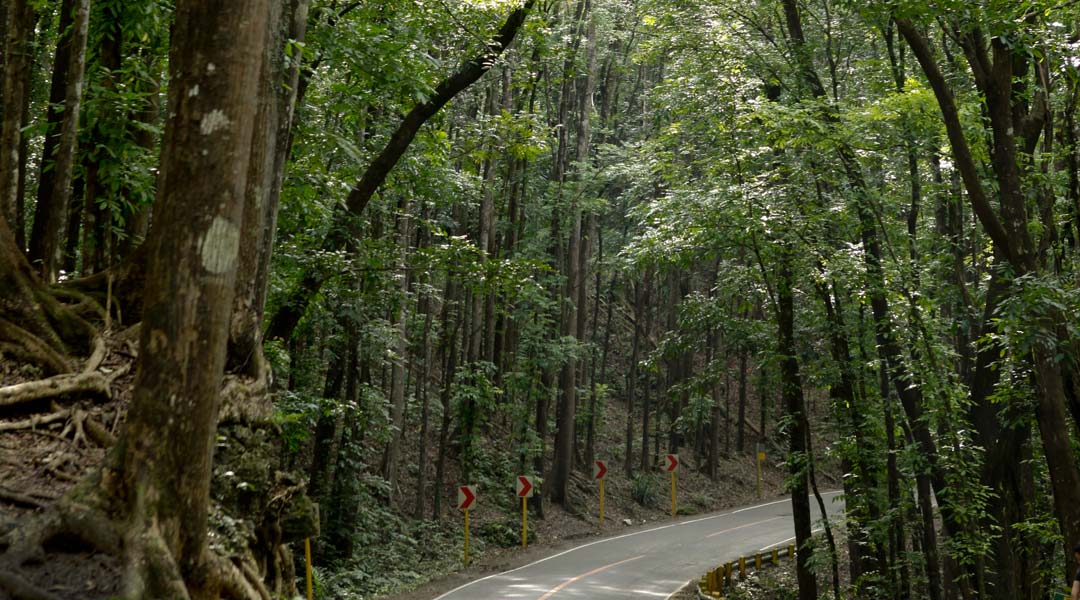
Hundreds of thousands of mahogany seedlings were planted over
857 hectares in Bilar, Bohol, in the 1960s and are now a forest of majestic
trees–and sadly for the ecosystem of Bilar and Loboc towns, very little of the
native wildlife.
What’s the big deal?
After getting over the initial surprise that many of the trees
we are familiar with are not native at all, people tend to dismiss native
species advocates as hardline and extremist. Those who do may argue, as the
Department of Environment and Natural Resources (DENR) does, that the exotic
species being planted, such as coffee, cacao, rubber and langka, will generate
economic security for farmers.
They may point out that quick-growing exotics will help us
regain much-needed forest cover faster, stabilize our watersheds and reduce
downstream flooding. They may also say that we need wood for fuel, and for wood
and paper products. What is wrong with planting exotics?
Biodiversity hotspot
The answer is, native plants support our native wildlife, and
exotic plants don’t. Exotics, particularly alien invasive species, enfeeble our
already endangered biodiversity, and weaken our food web. The Encyclopedia of
Earth says the Philippines is one of the few countries on the planet that is
“in its entirety, both a hotspot and a megadiversity country.” That means our
islands harbor one of the most diverse collection of living things on Earth,
and also one of the greatest number of endangered and threatened species.
What makes our situation critical is that a high proportion of
our life forms—at least one third of vascular plants, for example—are unique or
endemic to the Philippines. If these endemic species were to cease existing in
our country, unless they are successfully propagated elsewhere, they will
become extinct.
The case for dipterocarps
The rich plant and
animal life of our country took millions of years to evolve, each adapting to
and dependent on another and another in an intricate web of survival and
balance.
Our lowlands were
carpeted with rainforests dominated by towering yakal, tanguile, lauan,
apitong, bagtikan and 40 more species of the same family called dipterocarps.
Dipterocarps are the backbone of biodiversity in Southeast Asia. Hundreds of
species of insects, moss, fungi, etc., can be found in a single dipterocarp
tree, according to the ASEAN Biodiversity Information Sharing Service.
Unfortunately, dipterocarps were the most logged trees in our
country at the height of our timber trade in the 1980s, comprising over 90% of
the total volume of wood exported by the Philippines. And yet, despite being
the most exploited trees in our country, they are rarely used in land
rehabilitation and reforestation efforts. Instead, the government has favored
exotic tree species like mahogany, acacia and ipil-ipil, and recently, falcate
and gmelina.
Up until 2011, mahogany was the most planted tree of the National Greening Program (NGP). In 2012, in
response to urgings by native plant conservationists, mahogany slid down to
second place, giving way to the native narra tree. Still, the DENR’s list of
ten most planted trees does not include any dipterocarps.

Photo from blueprint
A Dipterocarpus
keruing seed
DIPTEROCARP NUMBERS
Source: Soil and Water Conservation Foundation,
Bohol
The dipterocarp family gets its name from the two (di)
winged (ptero) fruits (karpos) of the tree.
• 45 species of dipterocarps exist in the Philippines
• 20 are endemic
• 40 to 80 meters in height
• Up to 2 meters in diameter
• The tree starts producing flowers, fruit and seeds at the age of
17-18 years
• They flower every 7-8 years
The case against mahogany
Mahogany is not indigenous to the Philippines, but to the
forests of Central and South America. Says Anthony Abrias of the Philippine
Native Plant Conservation Society: “We just think they are native because at
the height of the timber industry in the Philippines (mid 1960s-1980s), the
dealers in the lumber trade, to simplify everything [and to ride on the demand
worldwide for the prized Honduran mahogany] decided to call all our hardwoods
‘Philippine mahogany,’ whether they were white lauaan, red lauaan, apitong,
mayapis, tanguile, almon, yakal, bagtican, etc.” So all these trees became
known simply as “Philippine mahogany,” even though these dipterocarps bear no
relation to the mahogany species.

Photo from blueprint
The most planted tree
of the National Greening Program in 2010 and 2011 was mahogany. Out of 392
million trees planted from 2010-2014, less than 20% of them were native.
Conservationists contend that the DENR did not do their
homework. Says Abrias: “The DENR’s preferred seedling species is mahogany. But
they did not specify that we should plant ‘Philippine mahogany.’ So here we are
with good intentions, buying and planting mahogany without asking where these
seedlings come from.”
Using mahogany to replenish our forests is ecological suicide.
One of the most vocal opponents to planting exotic trees is Dr. James
LaFrankie, author of Why Native Trees? He says: “Native
species [have] a relationship to the land, water and other organisms that have
developed over a million years. Certain fungi live with the roots, certain
insects feed on the plant parts, while others pollinate the flower. Birds and
mammals live along the branches and feed on the seeds. No such relationship
exists for the newcomer.
“The result is ten hectares of mahogany in a biodiversity-dead
zone. There are no birds, no insects, only a nearly dead soil due to the lethal
chemicals that leak from the rotting leaves. There is no future for ten
hectares of mahogany. It will remain as it is, until cut and replaced.”
Tarsier versus Mahogany.
One of Bohol province’s tourist attractions, the Bilar Manmade
Forest, is an 857-hectare biodiversity dead zone. Thousands of mahogany trees
were planted in the 1960s to 1970s, a government reforestation effort aimed at
stabilizing Bohol’s watershed which had been severely affected by rampant
logging, harvesting of firewood, and slash-and-burn for crop growing.
The successful project has been and still is hailed as a model
of public and private sector cooperation and volunteerism. The result is an
eerily beautiful stand of soaring trees, albeit entirely inhospitable to
Bohol’s most beloved icon, the endangered tarsier. Tarsiers prefer dense
thickets. They cling to slender branches of secondary growth around two meters
off the ground, and eat insects, small lizards and birds. They cannot cling to
massive mahogany tree trunks, and mahogany trees repel the tarsier’s prey.
Now it would be unfair to claim that the mahogany forest
displaced the tarsier. The land had already been barren, uninhabitable for the
tiny mammal. But the existence of the Bilar mahogany forest now precludes the
possibility of recovering the tarsier’s natural habitat in the area.
In order to ensure the survival of the tarsier, the government
of Bohol together with the Philippine Tarsier Foundation has earmarked 134
hectares of secondary forestland as a tarsier sanctuary where they can roam
undisturbed. This is hardly enough room for the specie to flourish, however.
Tarsiers are territorial, and their home ranges average 2.45 and 6.45 hectares
for females and males, respectively. They certainly could use the 857 hectares
now occupied by mahogany.

Dipterocarp trees such
as yakal, tanguile, guisok-guisok, bagtikan, guiho, almon, hagakhak, etc.,
are the backbone of Philippine lowland rain-forests. Without them,the
ecosystem collapses.
The best time to plant a tree
The bottom line is, indigenous trees and plants support
biodiversity. Exotics don’t.
Abrias says that native plant conservationists are not
extremists: “We recognize that exotic plants have economic uses for us, such as
pineapples, which are from South America. But if we’re not in the food
industry, if we’re in tourism and development, then let’s develop responsibly.
Since we have already lost 80 percent of our forest cover, and our wildlife are
dependent on forests, then let’s plant trees that are native to our country.”
Abrias concludes: “There’s a Chinese saying that goes, ‘The best
time to plant a tree was 100 years ago.’ To that we add: ‘The next best time to
plant is to plant a native tree today.’”
This article was originally published in
BluPrint Volume 3 2015. Edits were made for BluPrint online.
Source and Original
Article: >>> Blueprint

Comments