
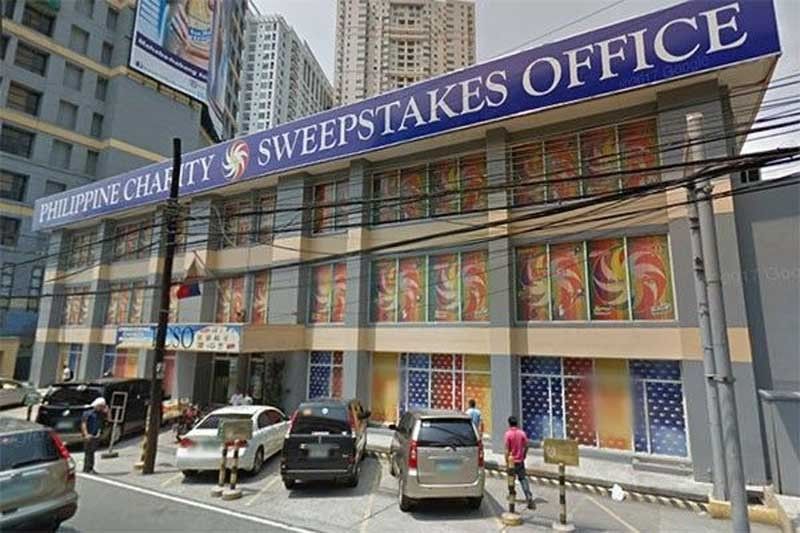
“PCSO has not declared and remitted dividends to the national government for dividend years 1994 to 2016 in the total amount of P8.426 billion, contrary to the provision under Section 3 of Republic Act 7656,” the COA’s 2018 annual audit report on the PCSO read. (Photo from PhilStar)
MANILA, Philippines — The Commission on Audit (COA) has called out the Philippine Charity Sweepstakes Office (PCSO) over its continued refusal to remit to the national treasury 50 percent of annual earnings as required by law, noting that the state gaming firm’s unremitted earnings or dividends stand at P8.426 billion as of 2016.
“PCSO has not declared and remitted dividends to the national government for dividend years 1994 to 2016 in the total amount of P8.426 billion, contrary to the provision under Section 3 of Republic Act 7656,” the COA’s 2018 annual audit report on the PCSO read.
Under Section 3 of RA 7656 or the Dividend Law, “all government-owned or controlled corporations (GOCCs) shall declare and remit at least 50 percent of their annual net earnings as cash, stock or property dividends to the national government.”
The Implementing Rules and Regulations (IRR) of RA 7656 further states that the GOCCs “shall annually declare and remit dividends” directly to the Bureau of Treasury on or before May 15 of each year.
The COA said that the audit team’s review of PCSO’s financial statements showed that the state firm had total earnings of P16.852 billion from 1994 to 2016; thus, it owed the government P8.426 billion in dividends.
The COA maintained that PCSO is not exempted from remitting its earnings to the national treasury as it was not among the exempted GOCCs enumerated in the IRR of RA 7656.
In a reply to the audit report, the PCSO said while the Department of Finance (DOF), in a letter addressed to COA dated March 16, 2016, had already confirmed that PCSO is not exempted from RA 7656, it still opined that the balances from PCSO’s operations shall be regularly reverted to its charity fund.
“To date, the PCSO is still in negotiation with the DOF on whether or not it would be required to remit the dividends for CYs 1994 to 2016 and is also in close coordination with the said department regarding the proposed settlement of arrears in dividends,” the PCSO said.
COA, however, maintained that while its negotiation with the DOF is pending, the gaming firm must “settle the P8.426-billion dividends in arrears due to the national government in compliance with RA 7656.”
Meanwhile, in the same audit report, COA said that as of Dec. 31, 2018, 67 out of the 85 authorized small town lottery (STL) operators, also referred to as authorized STL agents (ASAs) or authorized agent corporations (AACs), have yet to pay PCSO a total of P4.607 billion in presumptive monthly retail receipts (PMRR).
“We recommended that the management intensify collection of the PMRR shortfalls due from the concerned AACs/ASAs in the total amount of P4.607 billion so that the same can be utilized for various charitable programs of the PCSO, particularly the individual medical assistance program,” the COA said.
“Otherwise, implement Section 27 (f and g) of the revised IRR for STL and suspend and/or revoke their authorities to operate and forfeit their cash bonds corresponding to the amount of their PMRR shortfalls,” it added.
Source and Original Article from: >>> PhilStar

Comments