
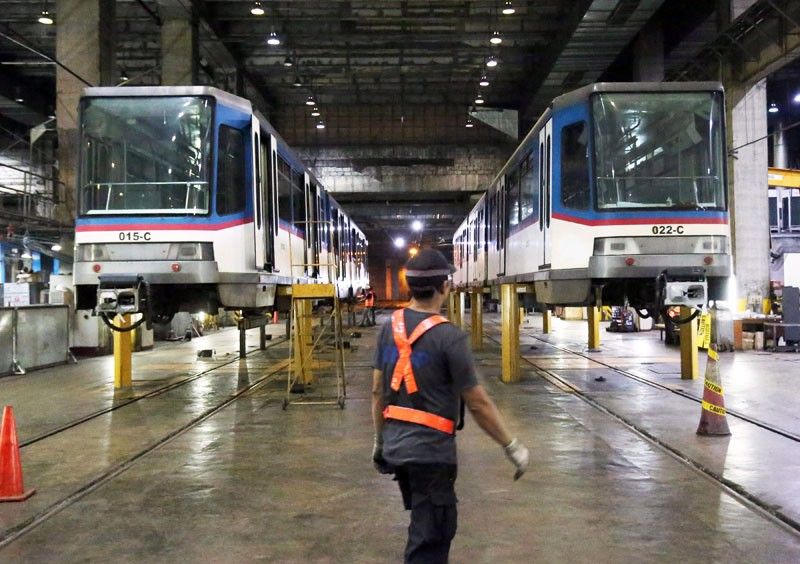
Photo from PhilStar
MANILA, Philippines — The government is planning to bolster the country’s fleet of operational train cars by more than five times by the end of the Duterte administration to boost connectivity and enable better and faster services across all rail networks nationwide.
Transportation Undersecretary for railways Timothy John Batan said the country’s rolling stock fleet of 221 operational train cars, also known as light rail vehicles or coaches, in 2016 is targeted to grow to more than 1,200 by 2022.
“As of today, we have already completed the order for an additional 369 additional train cars, with the 37 train cars of (the Philippine National Railways) starting delivery next month, 108 train cars for (Mass Rail Transit)-7 starting delivery toward the end of this year, 120 train cars for (Light Rail Transit)-1 starting delivery in the middle of 2020 and the 104 train cars for PNR Clark Phase 1 starting delivery in the fourth quarter of 2021,” Batan said.
In the next three months, the undersecretary said invitations to bid would also be published for three additional rolling stock contract packages for 600 additional train cars consisting of 304 commuter train cars for PNR Clark Phase 2 and PNR Calamba, 56 airport express train cars which will connect Clark International Airport to Makati in less than one hour and 240 for the country’s very first subway.
“Along with other orders that would be completed by 2020 for the 1,900-kilometer railway network that we are building throughout the country, under the leadership of Secretary (Arthur) Tugade, the Department of Transportation (DOTr) would have expanded our rolling stock fleet from 221 in 2016 to more than 1,200 train cars by 2022,” he said.
The DOTr yesterday signed the P12.1-billion contract for Package 3 of the PNR Clark Phase 1 with the joint venture of Sumitomo Corp. and Japan Transport Engineering Co.
Contract Package 3 of the 37.6-kilometer mass transit project that will connect Malolos, Bulacan to the National Capital Region pertains to the manufacture and delivery of a rolling stock fleet with a total of 13 train sets comprising of eight cars per train set.
The rolling stock will be designed to have a capacity of 2,242 passengers per train set, capable of running at 120 kilometers per hour.
Tugade said the train cars were originally scheduled for full delivery by the last quarter of 2021, but he requested delivery by no later than the third quarter of 2021.
He said the earlier schedule of delivery would make sure that the partial operability of the PNR Clark Phase 1 project covering the portion of Malolos to Valenzuela will happen by the end of the fourth quarter of 2021.
Contract Package 4 of the project, which entails electrical and mechanical works, is targeted to be awarded by yearend.
“So, by the end of the year, it is all systems go,” Tugade said.
Contract Package 1, which covers the construction of six stations – Solis, Caloocan, Valenzuela, Meycauayan, Marilao and Bocaue – and a depot, was signed last May 20 and is now in full swing.
Meanwhile, Contract Package 2 consists of the construction of three stations – Balagtas, Guiguinto and Malolos. Construction is in full blast as well after it was signed last Jan. 23.
Once the PNR Clark Phase 1 project is completed and fully operational by 2022, travel time from Manila to Bulacan will be reduced from one hour and 30 minutes to just 35 minutes, serving 300,000 passengers daily.
Source and Original Article: PhilStar

Comments